EVOKE 2026: Roxy's POV
- Konstantinos Trimmis
- 5 days ago
- 2 min read

Evoke 2026 began, for me, at an early hour standing at a busy gate at Athens airport. A girl approached me and tentatively asked, “Are you one of the archaeologists with Evoke?”. The hiking boots, backpack and 2L water bottle gave me away.
After a third team member found us, I boarded our flight full of nervous energy but an incredible excitement. Watching the breathtakingly beautiful island of Kythera materialize beneath me only managed to increase these emotions.
At Kythera’s tiny airport we were greeted by a professional cameraman. I looked around in confusion. Was someone famous coming to the island?
Turns out it was us.
It was immediately clear that Evoke 2026 was going to be different from other archaeological excavations. It wasn’t just about the excavation, it was going to be a holistic project incorporating public engagement, encouraging historical communication and allowing others to share in this experience with us.
As I always feel when first arriving in a foreign city, the next couple of hours were filled with a euphoric excitement at the utter unfamiliarity of my surroundings. The village of Potamos, which was to be my home for the next three weeks, felt like it was straight from the set of Mamma Mia: whitewashed buildings decorated with blue shutter windows interspersed through a village with only a handful of shops (operating on variable opening hours) bathed in a sparkling Mediterranean sun.

I felt myself watched not only by the plethora of adored local stray cats stalking us through the streets, but by the eyes of the local Kytherians who observed me from the village square, or plateia, quietly assessing the hoard of new archaeologists who had arrived on their island.
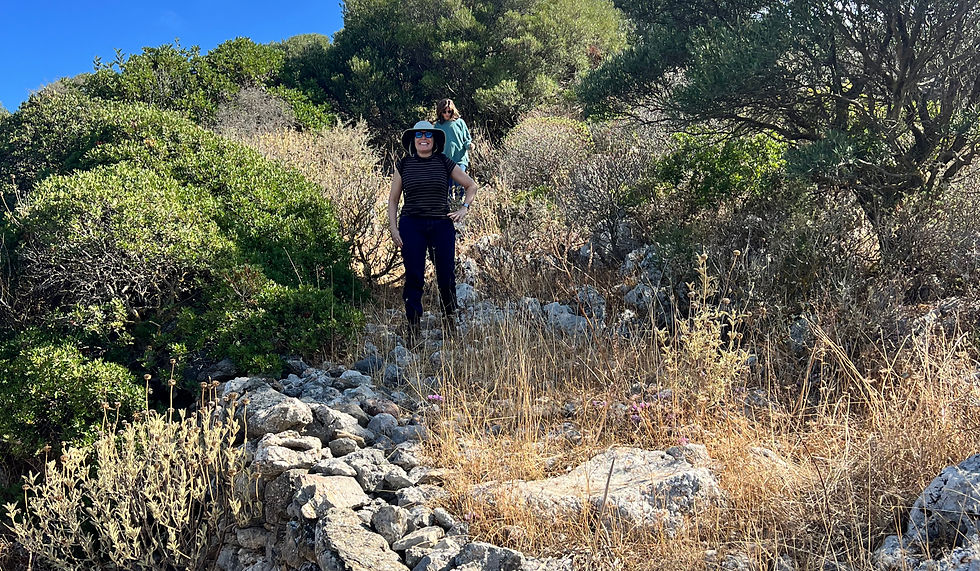
On Sunday night, I passed out after the exhaustion of new surroundings, new acquaintances and a hearty Greek dinner. Yet, a very early wake up on Monday morning quickly reminded me that this was no holiday, and as a convoy of cars carried students, staff and photographers towards our dig site of Vythoulas, I readied myself for the coming journey.
This was where I first experienced the great equalizing force of archaeological fieldwork. Hierarchical divisions between student and staff begin to dissolve when faced with the prospect of a hard ground awaiting nothing more than sheer physical power to break through its façade. Such a task necessarily required the united comradery of all, as we worked under the fierce gaze of Helios. While it felt like slow work, it was remarkable how much our team achieved in a matter of hours, and before we knew it a proper trench took shape before our eyes, gifting us small sherds of pottery for our labor.

The week followed in a similar pattern as everyone adjusted to our new schedule, and before I knew it, Friday appeared. Collectively, we had already found artefacts that promised more secrets to be uncovered below, shoveled and sifted through an unimaginable amount of dirt, and mastered our level of caffeine consumption in order to wield a pick-axe for a number of hours.
As I write this on Saturday, Athens airport truly feels like a lifetime ago, and the coming weeks hold eager anticipation of the as-yet-undiscovered.


Comments