Vythoulas: Evoking memories and landscapes strategies from the deep time
- Konstantinos Trimmis
- May 11
- 5 min read

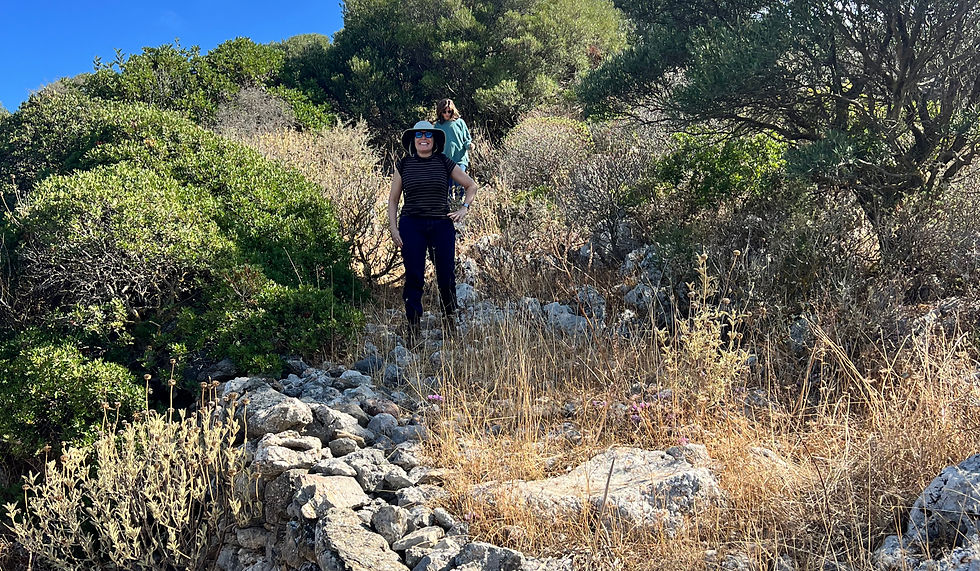
The first case study project of DIORAMAS, EVOKE: Exploring Vythoulas Origins in Kythera Environs, focuses on one of the most remarkable and least understood archaeological landscapes of northern Kythera: Vythoulas. Located northeast of the modern market village of Potamos and above the Agia Pelagia harbour, the hills of Vythoulas overlook the straits between Kythera and the Peloponnese. It is a landscape where geology, movement, farming, settlement, and memory meet. Its name, meaning “sunken ground”, reflects the form of the place itself: a deep, flat-bottomed valley framed by hills, ravines, and passages that connect the uplands of Potamos with the harbours of the eastern coast.

A connected landscape
Vythoulas was never an isolated place. It sits within a wider zone of fertile valleys and rolling hills, an area historically known as Pentayioi, or “the five saints”. This was one of the main agricultural landscapes of the island, still partly cultivated today with olive groves and vineyards. Among these hills, the twin heights of Xestratigos dominate the landscape. They form the central focus of the archaeological site and one of the most important archaeological areas recorded by the Australian Paliochora Kythera Archaeological Survey (APKAS), which took place between 1999 and 2023.
The importance of this landscape begins with its geology. The ravines northeast of Potamos are rich sources of micaceous orange clay, a major raw material used for pottery, tiles, and bricks on Kythera from prehistory to the modern period. In this sense, Vythoulas was not only a place where people lived; it was also part of a working landscape of extraction, craft, cultivation, and movement. The clay beds, alongside tracks, terraces, and hilltops all form part of the same long story of human engagement with the island’s resources.
The historical record points to the existence of now-lost settlements in this wider area. One of these, known in written sources as Arkarion or Arkari, appears in Venetian-period records and had 60 inhabitants in the census of Petros Kastrofylakas in 1583. By 1697, however, the churches of Saint George and Saint Stephen associated with Arkari were described as exomonia (churches that are not parish churches of a village) suggesting that the settlement itself had already disappeared. Another settlement, recorded as Alligari or Allicangri, had 125 inhabitants in 1583 and is thought to have been located at the northeastern edge of present-day Potamos, close to the area surveyed by APKAS around Vythoulas. The nearby church of Agios Nikolaos and Savvas, which may date to the 13th century, hints at an even earlier Medieval presence in this part of the landscape.
A site from the Deep Time
Yet the story of Vythoulas reaches far deeper than the Medieval and Early Modern periods. Survey work has shown that the hills around Xestratigos church preserve one of the largest and most significant archaeological sites on Kythera. The evidence begins at least in the Final Neolithic period and continues through the Bronze Age, including the Mycenaean period. Prehistoric pottery is concentrated mainly within an inner perimeter wall that follows the contours of the hilltops, suggesting a clearly defined early settlement zone. Around 250 sherds recorded by APKAS can be dated to different phases of the Bronze Age, while further evidence from nearby areas such as Koufarika and Agios Georgios suggests a wider pattern of satellite activity around a dominant central site.
During the Classical and Hellenistic periods, Vythoulas expanded dramatically. A second, outer perimeter wall enclosed a much larger sloping area overlooking Agia Pelagia, the Kythera straits, and Vatika Bay. The area within this outer wall covers almost nine hectares, making Vythoulas potentially one of the largest archaeological sites on the island. More than 300 sherds from the area can be dated to Classical antiquity, with activity especially strong in the Archaic and Classical periods before declining in later periods. Roman material is also present, and the hills show renewed activity around the 6th century CE.
One of the most striking features of Vythoulas is what is missing. Unlike other parts of Kythera, such as Amoutses or Kastri, there is no known cemetery area or group of rock-cut tombs clearly associated with the prehistoric occupation of the site. This absence may point to a different local tradition in the treatment of the dead, or to burial practices that have not yet been identified archaeologically. Earlier references to a Classical cemetery on the southeastern slopes of Xestratigos hills by I. Petrocheilos remain difficult to confirm, although possible rectangular rock cuts observed in 2020 by the APKAS team may relate to this tradition and deserve further investigation.
In the Medieval period, activity on the Xestratigos hills declined sharply. Finds are mainly concentrated around the Byzantine church of Xestratigos, indicating the continuing importance of churches as landmarks, boundary markers, and expressions of territorial presence. This pattern changes again in the 17th century, when activity in the area increases, before peaking in the mid-19th century during a period of wider demographic growth in northern Kythera. At that time, Vythoulas formed part of an agropastoral landscape used by families from Potamos, who established seasonal hamlets named after family groups, such as Fardoulianika and Chambeanika. From the 1930s onwards, this landscape was gradually abandoned, although some fields in the valley continue to be cultivated today.
This deep chronological range is why Vythoulas is the ideal case study through which to investigate how people shaped, used, abandoned, and remembered a landscape over thousands of years. We are assessing how water, clay, fertile soils, routes, hilltops, churches, and field systems structured human life from the Neolithic to the modern period. We are also exploring how past communities responded to environmental constraints and opportunities, especially in relation to farming, water management, movement, and settlement organisation.
EVOKE as part of DIORAMAS
As part of DIORAMAS, EVOKE approaches Vythoulas not simply as an archaeological site, but as a living landscape biography. The project brings together excavation, survey, geospatial recording, digital documentation, environmental study, and community engagement to reconstruct how this part of Kythera became meaningful across time. From prehistoric occupation on the Xestratigos hills to Classical expansion, Byzantine churches, Venetian-period settlements, seasonal farming hamlets, and modern abandonment, Vythoulas offers a rare opportunity to study continuity and change in one of the most important cultural landscapes of the island.
Vythoulas holds many of the questions that DIORAMAS seeks to address more broadly: how island communities lived with limited resources; how landscapes were transformed through movement, cultivation, craft, and belief; how places became centres, boundaries, refuges, or memories; and how archaeological research can help us understand not only the past, but also the future of fragile Mediterranean landscapes. EVOKE brings these into the present to foster sustainable futures.


We are Greek Australians holidaying on the island for a month. We are always keen to visit and learn more about the history of the island. Will there be any possibility of the public coming to view the dig?
Hi
I find the project very interesting
Please tell me if you would be interested to make the story known for Greek Australians from kythera. If you consider please be in touch with me at: Manoli.mavrommatis@sbs.com.au
I m radio producer for SBS radio Australia
My number 0414153030