Interaction Design in Archaeology
By Manasi P.
I am a 4th year undergraduate student at the University of Sydney studying Archaeology and Interaction Design. “What’s the connection?”, you may wonder. Well, I’ve wondered that myself for a long time. I had simply chosen the two majors to pursue my two very different interests, with no expectation of linking them together.
Interaction Design, also commonly referred to as User Interface/User Experience (UI/UX) Design, focuses on enhancing human experiences through designing meaningful, creative, accessible, and engaging digital and non-digital solutions. It encompasses primary and secondary research to identify pain points for target users, and to creatively ideate, develop, design, prototype, and test efficient, user-friendly solutions. Its aim, ultimately, is to simplify complex ideas and problems when it comes to product use, whether for a real object or digitally. What drew me to study Interaction Design was its creativity and real-life impact, because it genuinely caters to and improves users’ lives.
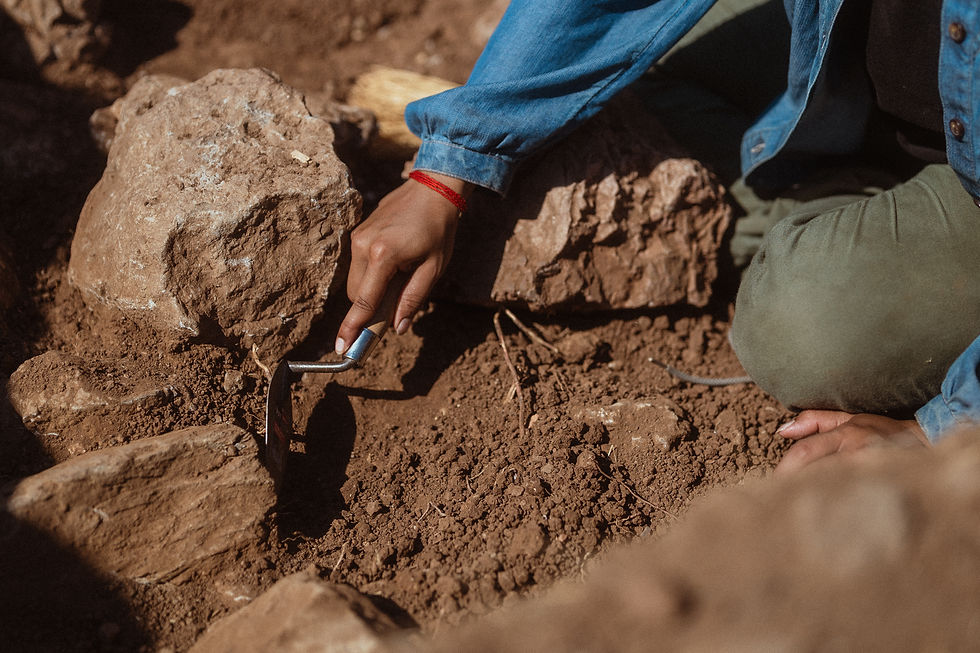
Archaeology, as the study of the past through its material remains, stands in contrast to the living present of Interaction Design. Archaeology involves the careful excavation and recording of the tangible evidence of lived history in the form of pottery, metals, soil samples, and much more. I have always been fascinated by how these aspects of archaeological research reveal information about past lives that written and visual sources may not share.

When I first read about the EVOKE project, I was very excited by the opportunity, as it would be my first dig, and I feel blessed that this experience has been with such a wonderful team, a beautiful site on a quintessential island, and a plethora of real-life experiences excavating — I truly couldn’t have asked for better. I also thought to myself that I would be focusing only on Archaeology these 3 weeks, since how could UX Design be even remotely relevant here? However, I was delighted to quickly identify a strong connection between my two disciplines, which has blossomed into a beautiful collaboration.
One of the key aspects of any archaeological excavation is post-excavation work, where all finds and materials are processed for further research. For EVOKE, this meant transporting all our finds and samples at the end of each field day to our base of operations, the former nursery school in Potamos, where every afternoon we washed and sorted pottery and organised material for future study. This is a complex process, and since it was the early days of a brand-new excavation, the steps specific to our project had to be articulated for everyone. It begins with where material should go in the post-excavation lab when it comes in from the site, and it incorporates instructions on how to preserve context information while material is being washed and sorted — through identification, recording, and re-bagging — and how to organise the finds for further study. This is when I had the epiphany that my background in Interaction Design could be very relevant. I investigated the challenges students and staff faced with regard to the multiple steps, and I designed a flowchart using Figma, an online design tool, that visualised and simplified the entire process from arrival to post-sorting storage so that the team could cross-check the flow and avoid confusion along the way. For example, it highlights where the re-bagging of material is essential or optional, enabling those of us new to fieldwork to be more efficient and confident.
This was not simply a matter of spelling out each step. There is no single method of finds processing or materials recording; each country has its own conventions of practice and terminology. Our team is international, and we are incorporating best archaeological practice from different fieldwork traditions to best meet the needs of EVOKE. The flowchart integrates simple but key design practices to be visually appealing as well as directly useful, for it provides a detailed legend table and a key-terms table so that our team members could follow the steps easily regardless of their experience levels and primary languages.
Although this was a very simple contribution, the team found it to be an extremely valuable one! This really made me think — how could UX Design be integrated into archaeological excavations further to improve the many complex processes that fieldwork compasses?
Broader applications of a User Experience Designer in archaeological projects could be:
Creating cleaner, cohesive, and visually engaging documents to simplify
logistical processes, harmonising experience differences;
Designing a website with flexibility to cater more easily for increased web traffic
as a project expands its activities over time;
Optimising social media presence;
Conducting primary research to enhance participant and visitor experience of an
archaeological site/fieldwork project.
This has led me to realise that archaeological projects need an Interaction Designer! This is because Interaction Design has the power to assist in making Archaeology a more inclusive discipline. For example, we recognise that everyone learns in different ways. Some prefer instructions in the form of lists, while others benefit more from visual diagrams. And not everyone on a fieldwork project may have the same first language. My contribution in designing the flowchart highlighted how necessary it is to use UX design methods to streamline international methodologies, vocabularies, and diverse learning experiences into visually engaging materials that ultimately improve inclusivity and efficiency in archaeological fieldwork.

I now recognise that Interaction Design and Archaeology can be a powerful collaboration that offers creative solutions to enhance real life experiences for a wide range of people both visiting and working at active archaeological sites. I look forward to putting this into practice in the future.


Comments